WATER DAMAGE GUIDE
ANY HOMEIN THE US
Burst pipe
Private guide. Not a government service.
Burst pipe: what to do now
Close your main water shutoff valve first to stop the flow. Then call a plumber to repair the pipe, and a water damage company if water soaked walls or floors.
Start the shutoff steps Step 1 says where to find your main valve.
WATER DAMAGE GUIDE
ANY HOMEIN THE US
Burst pipe
Private guide. Not a government service.
Start the shutoff steps Step 1 says where to find your main valve.
Do this now
- Close your main water shutoff valve where the supply pipe enters the house. In an apartment, call your building manager.
- Stay clear of wet outlets, cords, and lights. Never use the breaker box if you are wet or must stand in water. If you cannot reach it safely, call your electric utility.
- Release the pressure in the pipes after shutoff. Close the shutoff valve on your water heater, open your faucets, and flush your toilets.
- Take photos and videos before cleanup of the broken pipe and every wet wall, floor, or item.
Who to call
A pipe leaks, burst, or you cannot find a hidden break?
You need a plumber. A plumber finds the break and repairs or replaces the copper, PEX, or PVC pipe.
Call a licensed plumber.
Call a plumberNo phone line here yet
No phone line is open here yet. We count taps, with no personal data, to know if people need one. Go to "Do this now" steps
Water soaked into walls, ceilings, carpets, or subfloors?
You need a water damage company. Its crew extracts standing water and sets up drying gear for wet walls and floors.
Call a water damage restoration company.
Call for cleanupNo phone line here yet
No phone line is open here yet. We count taps, with no personal data, to know if people need one. Go to "Do this now" steps
Renting? Call your landlord or property manager first.
Your insurer may suggest a company. Ask whether you can choose your own.
Stopped a small clean leak under one sink and only tile got wet? Mop it up, run a dehumidifier, and read our water damage restoration cost guide before you book repairs.
Where is the main shut-off valve?
The Portland Water Bureau, the City of Hamilton, OH, and the Regional Water Providers Consortium name the five spots below. Portland says most shutoff valves sit where the water line enters the house.
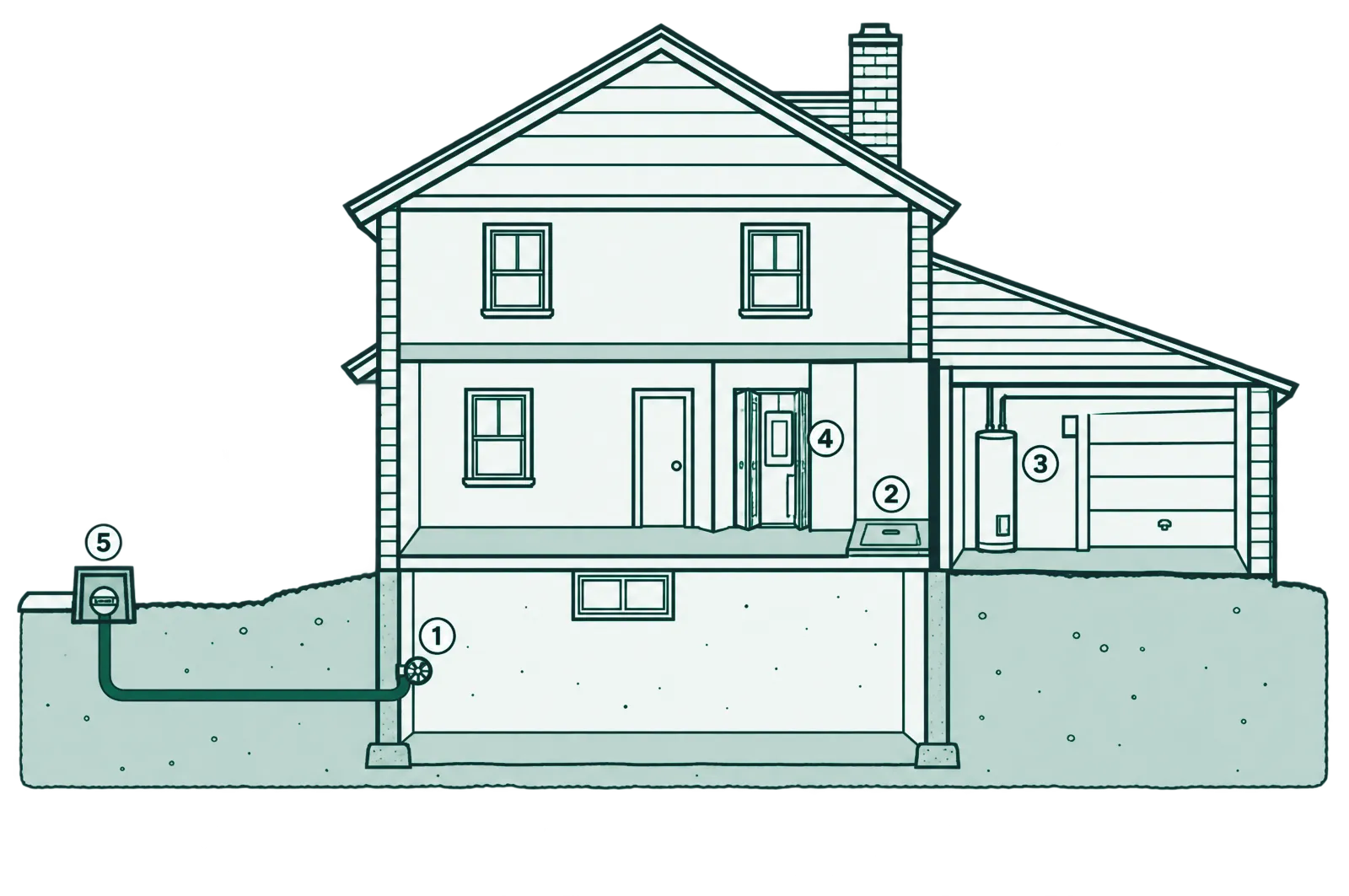
- In the basement (Portland, Hamilton, and the Consortium). Portland names the spot near the water heater.
- In the crawl space or under the house (the Consortium)
- Inside the garage (Portland and the Consortium)
- On an outside wall in a utility area (Hamilton)
- At the water meter box by the street (the Consortium). Ask your water provider before you use it. In freezing weather, Portland says to leave the box closed.
How do you close the main shut-off valve?
Hamilton and the Consortium describe two common valve types:
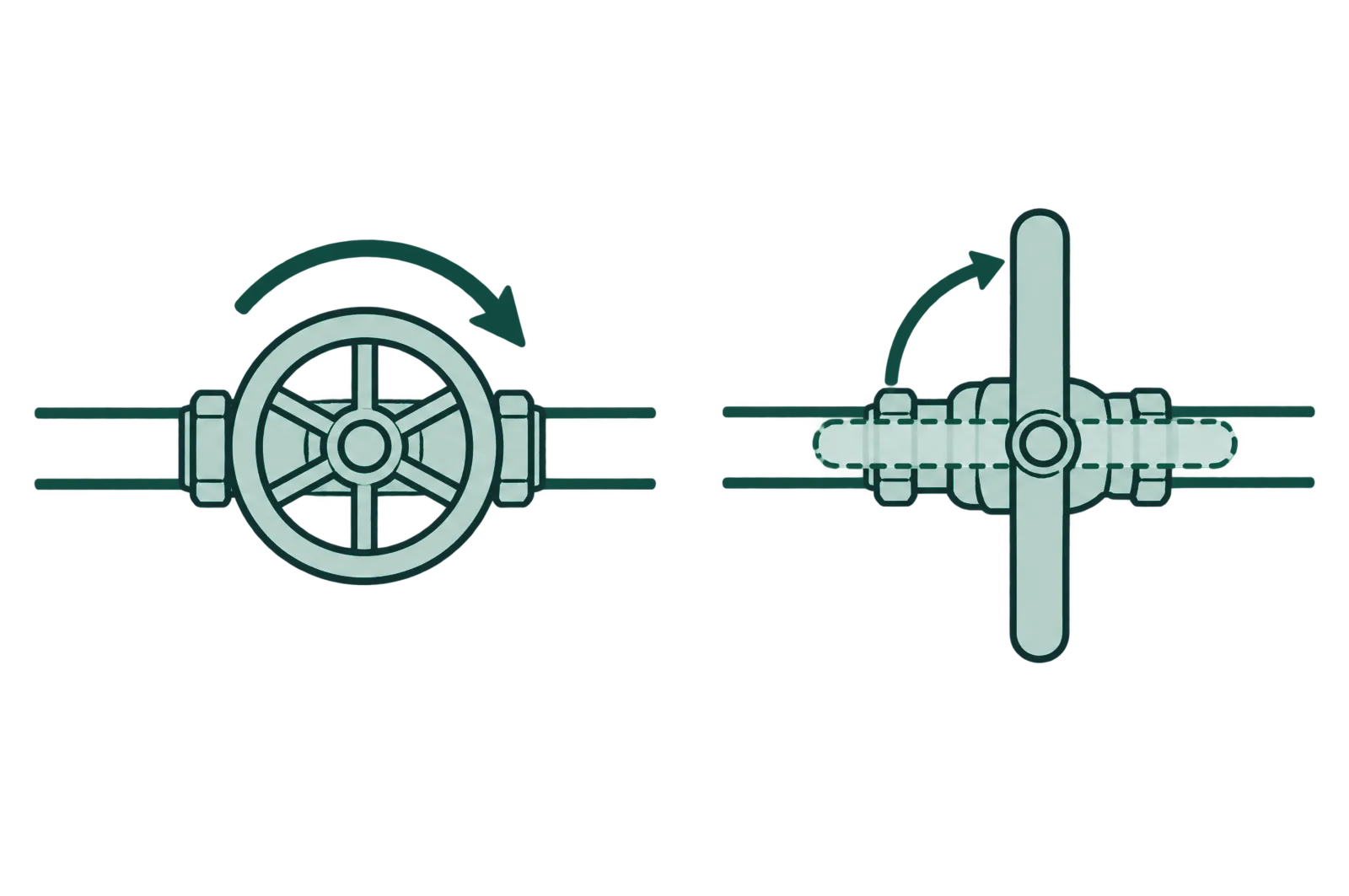
- Round wheel (gate valve): turn the wheel clockwise (to the right) until it is snug. It may take two or more full turns to shut off the water.
- Lever handle (ball valve): turn the lever until it lies crosswise to the pipe. Hamilton says a ball valve should stop at a quarter turn. The Consortium says it takes a quarter or half turn to the right. The amount depends on the valve type.
No shutoff valve in your home? The Consortium says to call your water provider to turn off the water at the street.
How do you know a pipe has burst?
When a pipe bursts, water does not always spray into plain view. A broken pipe behind drywall or under a floor leaves quieter clues first. These come from Fixr’s Burst Pipe Repair Cost guide, Nationwide, and the mold guide from the US Environmental Protection Agency (EPA):
- Sudden drop in water pressure (Fixr) or weak or stopped flow at faucets (Nationwide)
- Dark water stains on walls or bulges in ceilings (Nationwide), or damp spots on walls, ceilings, or floors (Fixr)
- Puddles of water on floors (Fixr)
- Unusual noises from the pipes (Fixr)
- Visible mold or a bad smell on walls (Nationwide), or a moldy smell with no visible source (EPA)
- A sharp jump in your monthly water bill (Nationwide and Fixr)
Is the water coming from a water heater, not a pipe? See our water heater leaking guide.
Nationwide advises calling a plumber as soon as you find the source of the leak. Once the leak stops, mop up standing water and run a dehumidifier. The EPA says to dry water-damaged areas within 24 to 48 hours to prevent mold, and Nationwide calls this step a race against mold. If water soaked inside walls, under floors, or through a ceiling, call a water damage company too.
What are common causes of water pipe failures?
Fixr names these common causes:
- Hard freezes: water expands when it freezes inside pipes, which cracks or weakens the line and pours out once ice thaws. See our frozen pipes guide if cold weather caused the break.
- Pipe age: older lines wear down over time and weaken.
- Corrosion: metal pipes corrode over time, especially where they touch another metal or mortar.
- Sudden changes in water pressure.
How a plumber repairs the break depends on the pipe material. For metal pipes, the plumber cuts out the damaged section and solders in new pipe. For PVC or other plastic pipes, the plumber may replace a section or seal a small leak with bonding tape or epoxy (Fixr).
Who is responsible for external water pipes?
The property owner usually pays for breaks on the house side of the water meter. Portland states that broken pipes on the customer side of the meter belong to the property owner. Fixr notes the same rule for lines in your front yard.
If water bubbles up from a street or sidewalk outside your meter, report a possible main break to your water utility. Some utilities adjust your water bill after you repair a leak, as Portland does.
How much does it cost to fix a busted pipe in the wall?
Fixr reports a national average range of $200 to $1,000, with most homeowners paying about $500. A minor patch starts near $150, while hard-to-reach lines can reach $2,000.
For a broken pipe inside a wall, Fixr lists $150 to $500 for the pipe plus $75 to $700 for wall repair. Exposed basement or front yard breaks run $200 to $600, and pipes under a concrete slab run $500 to $4,500. Fixr puts plumber labor at $45 to $200 per hour. Those numbers cover the pipe fix only. Water extraction and room rebuild cost extra, so see our water damage restoration cost guide for cleanup ranges.
Will insurance cover a burst water pipe?
The National Association of Insurance Commissioners (NAIC) says homeowners policies cover damage from a sudden and accidental discharge from a plumbing system. Nationwide says homeowners insurance will generally cover sudden water damage from a break in your water supply pipe. Nationwide also says your insurance would cover water damage from a frozen pipe that broke while you kept your home adequately heated.
Policies usually exclude water damage from gradual leaks and slow seepage over days, weeks, or months (Washington State Office of the Insurance Commissioner, Nationwide). Neglect can also cost you coverage. The NAIC says your policy may not cover damage from a burst pipe if you did not take steps to prevent freezing. Nationwide gives an example: in a cold area, you turn off the heat before you leave but leave the water on, and the pipes freeze and burst. Many policies pay for damaged walls and floors without paying to replace worn plumbing itself (Nationwide).
Not sure what your policy covers? Read our water damage insurance guide, or contact your state insurance regulator through the NAIC Insurance Departments directory.
Protect the house right away. So stop the water and start the drying now.
How do you find a good plumber?
Even in an emergency, take two minutes to check the person you hire. The Texas State Board of Plumbing Examiners recommends these checks before you approve work:
- Ask for the master plumber’s state license number and check it with your state licensing board
- Confirm the company carries active liability insurance
- Check complaint records with your state plumbing board or city inspection office
- Ask if the repair needs a city permit and inspection
- Get a written estimate with the exact work, hourly or flat price, and written warranties before work starts
- Ask for and check past customer references
This is general information, not legal or insurance advice.
Sources
- How to prepare your plumbing for winter weather, City of Portland Water Bureau
- Emergency Water Shut-Off, Regional Water Providers Consortium
- Operating Water Shut-Off Valves, City of Hamilton, OH
- What to Do When a Pipe Bursts in Your Home, Nationwide
- Does Home Insurance Cover Plumbing?, Nationwide
- Will My Homeowners Insurance Policy Cover Water Damage From a Burst Pipe?, National Association of Insurance Commissioners (NAIC)
- Leaks, water damage, and mold, Washington State Office of the Insurance Commissioner
- Insurance Departments, National Association of Insurance Commissioners (NAIC)
- Consumer Information, Texas State Board of Plumbing Examiners
- A Brief Guide to Mold, Moisture and Your Home, US Environmental Protection Agency (EPA)
- Unexpected indoor waterfall? Home or renters insurance might help., Texas Department of Insurance
- Flooding Provides Its Own Set Of Electrical Hazards, Safe Electricity
- Burst Pipe Repair Cost, Fixr
We checked every fact on this page against the sources below on .